News

It is not known when exactly the original Tedworth House and estate was built and created or when the first equine was connected to it. However we do know that Thomas Smith bought the Estate with a substantial, fine country residence in 1650. It is from this point therefore that Tedworth Equestrian, The Armed Forces Equine Charity, heritage begins.
John Smith, the grandson of Thomas, became the third of the Smith dynasty to own the House and estate. He was to become a famous political figure entertaining the rich, powerful and famous at Tedworth House. John Smith was MP for Beeralston in Devonshire in 1691 and Andover in 1695. He became Lord of the Treasury just before the opening of the Bank of England, Chancellor of the Exchequer in 1699 and Speaker of the House in 1705.
A series of descendants of Smith continued to inherit the House until William Smith, an Army Captain, died without an heir in 1773. It was his sister Harriet who provided hereditary continuity when she married Thomas Assheton, the Governor of Chester Castle, at South Tedworth Church. Out of respect for the long line of Smiths, Thomas Assheton adopted the family name, becoming Thomas Assheton-Smith.
In due course his son, Thomas Assheton-Smith II inherited the estates. A formidable character, he was a keen sportsman and renowned hunter. Like his predecessor, he too became MP for Andover as well as Squire of Tidworth. Thomas and his wife had 8 children; one of his sons distinguished himself at the Battle of Trafalgar as a Royal Navy Officer but died at sea a few years later. Assheton-Smith II died aged 77 in 1828 and his son Thomas Assheton-Smith III (1776 -1858) arranged for the virtual demolition of Tedworth House, which was then rebuilt to his specification. It is largely this house, rebuilt between 1828 and 1830, that stands today.
It is also at this time that Assheton-Smith III built the impressive Stable building in a hollow square to house his Hunt, which became one of the most famous in the country. By 1845 it housed 50 horses and 400 hounds. He was a brilliant horseman and sportsman and cleared vast tracts of land for the use of his hunt, laying the foundation of what we know today as Salisbury Plain Training Area. He eventually opened up 400 square miles of hunting country around Tedworth and it is known that, in 1830, he would go up to London in a carriage pulled by six horses in the early morning to attend Parliament and return after lunch to ride with the Hunt. He was known as the foremost horseman in the country and was Master of Hounds for 50 years.
The Duke of Wellington was a regular visitor to the house and an accomplished billiards player. He had many close matches with his host who at this time was believed to be the richest commoner in the country.
Assheton-Smith III died childless in 1858 aged 82 and was buried in Tedworth. The house was left to his favourite Godson Francis Sloane Stanley. Thus ended the 200 years of the Smith dynasty.

The new owner declined to move to Tedworth and let the Estate to a series of wealthy and distinguished tenants including Lord Broughton, a Cabinet minister and Secretary for Ireland, and Edward Studd, a rich planter recently returned from India. Studd housed 20 racehorses in the stables at Tedworth and built a racetrack in Tedworth Park. He trained the 1866 Grand National winner Salamander which came in at 40-1. Edward Studd’s life underwent a fundamental change when he attended an evangelist meeting in 1876. He sold his horses and much of his furniture and became an evangelist preacher.
In 1877, the House and the Estate of 6,600 acre was sold to Sir John Kelk (whose previous estate has became famous as the Command centre for RAF Fighter Command in World War II). Kelk planned major alterations; in 1878, using a workforce of 200 men, he restructured the house and planted the magnificent avenue of Lime trees which stand today. He also built St Mary’s church, which was used as the South Tidworth village church until it was declared redundant on 1 Sept 1972 when the parishes of North and South Tidworth were joined ecclesiastically. Sir John Kelk died in 1886 and was succeeded by his son, Sir John William Kelk, the second Baronet.
Sir John William Kelk sold the estate to the War Office in 1897, consisting of 6,616 acres of land including Tedworth House, 13 farms, 8 farmhouses, 107 cottages, and the Ram Inn Pub. For this, he received £95,000. For a further £450,000, the War Office purchased 40,000 acres of Salisbury Plain for military training; which at this time was either conducted mounted on horseback or on foot. Tedworth House was handed over to the newly appointed Commanding Royal Engineer, Salisbury Plain, Col R M Barclie, who located his Staff and the Drawing Office there while he supervised the building of new Barracks. These barracks were largely for the mounted regiments of the British Army as they returned from campaigns in India, Afghanistan, the Middle East and Africa. Many of these Regiments had distinguished themselves in the Crimean War (Lord Cardigan and the Charge of the Light Brigade) and the first and second Boer Wars. The Barracks in Tedworth Garrison took their names from where many of the relocated units had served, such as Jellalabad, Delhi, Hyrdabad, Bhurpore and Candahar to name just a few. These regiments used Tedworth Park and the surrounding Salisbury Plain to practice their mounted manoeuvres and nearly every barracks had their own stables.
From 1901 to the day horses left the battlefields after World War 2, mounted war fighting skills were honed on the fields of Tedworth Park. Today, conventional battlefield support and mobility no longer require War Horses although Special Forces did use horses in Afghanistan 2001-5 to great effect.
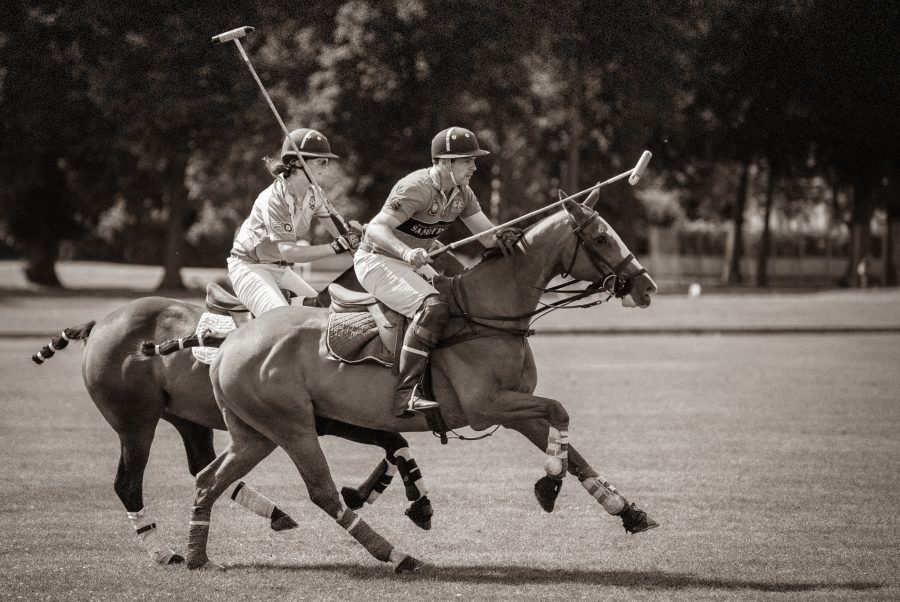
Military Polo helped develop excellent mounted skills and the troops themselves levelled the pitches, one of which still bears the name of the Commander of the Cavalry Brigade, Brigadier B D Fisher, CB, CMG, DSO.
Tedworth Park still remains the home of Armed Forces Polo and is the host for one of the most important fixtures on the polo calendar, when teams from the Army and the Royal Navy compete for the Rundle Cup. HRH The Prince of Wales and members of his family are often among the team members.
Tedworth also provided an equine orientated social and welfare function for the community. The Southern Command Horse Show was first held in 1927 and The Army Horse Trials started at Tedworth in 1952. The Estate also hosted Military Tattoos, the first of which took place on the grounds in front of the house in 1920. These quickly grew to rival those held in Edinburgh and Aldershot in popularity and continued until 1972. Special Tattoos were more recently held to mark the Millennium in 2000 and the Queen’s Golden Jubilee in 2002.
With such a strong equine heritage it is unsurprising that the Armed Forces Equine Charity adopted the name Tedworth Equestrian. In 2019, Tedworth Equestrian, The Armed Forces Equine charity was formed. This national community charity ensures that horses continue to play a vital role in the efficiency and effectiveness of the armed forces.
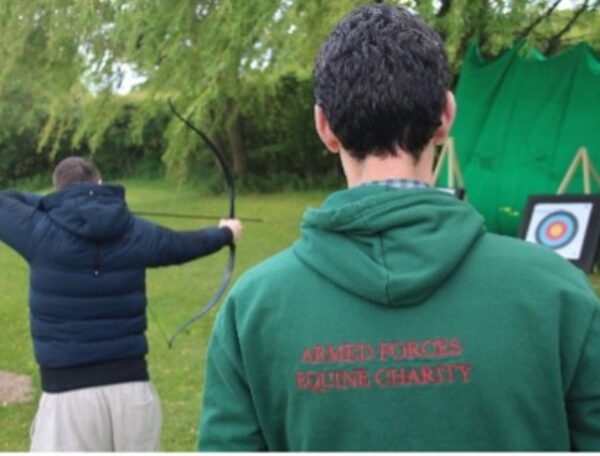
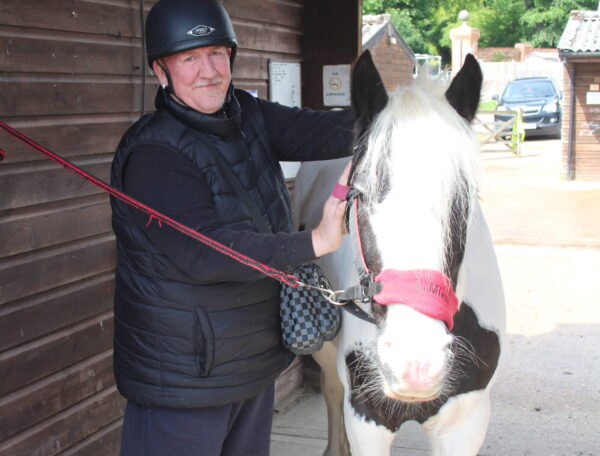
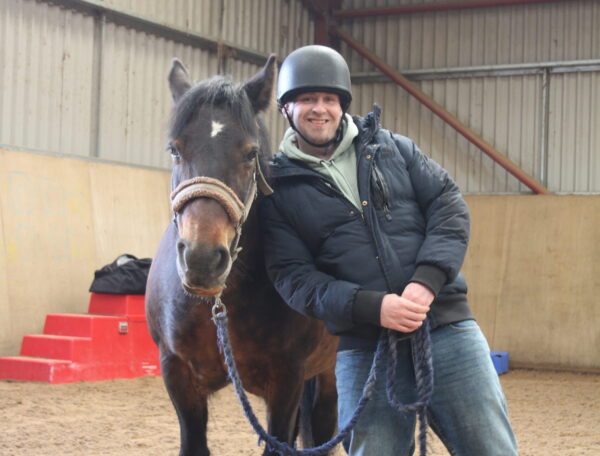
The charity’s horses and staff provide appropriately focussed equine therapy for those individuals facing mental and physical challenges and assist adults and children with special needs through equine learning programmes. The charity supports equine recovery programmes for those who benefit from interaction with the animals; these include individuals who have been challenged by: anxiety and depression; likelihood or actual loss of a loved one; alcohol and drug dependency; domestic abuse; violence and isolation. The demand for this support has significantly increased as a result of COVID 19 and the charity has a vital role to play in the nation’s recovery from these unprecedented times.
The charity promotes the benefits of an active lifestyle by making equine sport and recreational activity available, accessible and affordable for all.
In defining its beneficiaries, the charity uses the approved government definition of Armed Forces Community which is: those currently serving and their dependents, veterans and those who have been bereaved and the local community in which the Armed Forces are based. Evidence to date indicates that as many as 25% of this population requires the sort of support the charity provides. With a target beneficiary group of approximately 1.5 million people, the charity has some way to go to reach all of those it is set up to support.
There are a number of equine centres in the UK either created by, affiliated with, or supported by The Armed Forces Equine Charity. These equine centres often become vital community welfare hubs, where individuals will share experiences and develop friendships. This is particularly important for a community where so many have household members away on high risk military duty and are constantly moving locations to meet the needs of service.
Sir Winston Churchill made many visits to Tedworth. He recognised the power of the relationship between horses and humans and that riding a horse improved a person’s mental and physical health. He stated that “no hour of life is lost that is spent in the saddle”.
There is debate over the origins of another very famous quote: “There is something about the outside of a horse that is good for the inside of a man”. Whether these words were spoken by Churchill or not, the charity knows that the sentiment has never been more relevant and therefore enables and assures that horsepower continues to be used to support the Armed Forces Communities today.